Albumin Reagent Kit (Bromocresol Green)
Bromocresol green reagent for quantitative albumin in serum.

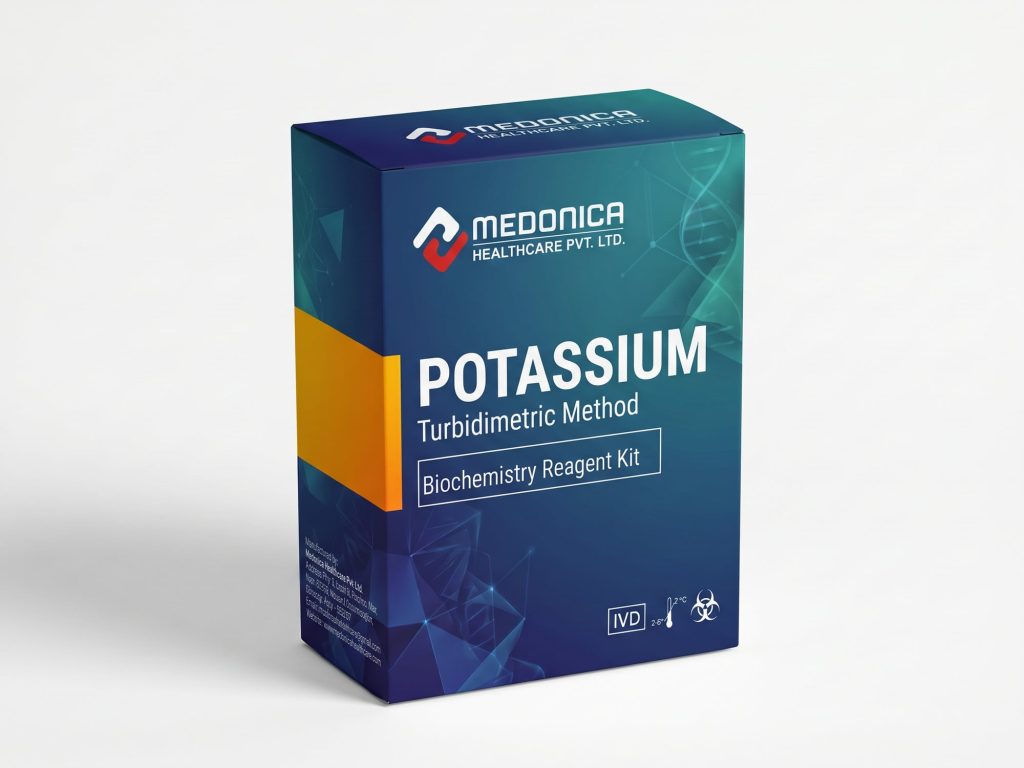
Sodium tetraphenylboron reagent for quantitative potassium in serum.
For in vitro diagnostic use by laboratory and healthcare professionals only. Please refer to the instructions for use supplied with each product for complete protocol and performance details.
For in vitro quantitative determination of potassium concentration in serum. Principle: Potassium reacts with sodium tetraphenylboron in a specially prepared buffer to form a colloidal suspension; the turbidity is directly proportional to serum potassium. Separate serum from the clot promptly, as potassium leaches from red cells. If potassium exceeds 7 mEq/L, dilute the sample, re-assay and multiply by the dilution factor.
Intended use: For in vitro quantitative determination of potassium concentration in serum.
| Shelf life | 12 months |
|---|---|
| Storage | 2–8 °C, protected from light |
| Method | Sodium tetraphenylboron (turbidimetric) |
| Sample type | Serum free of haemolysis, separated from the clot as soon as possible |
| Wavelength | 630 nm |
| Reaction type | End point |
| Reagent volume | 1 mL |
| Sample volume | 10 µL |
| Incubation | 5 minutes |
| Reaction temperature | 37 °C |
| Light path | 1 cm |
| Standard | 5 mEq/L |
| Linearity | 7 mEq/L |
| Reagent composition | Reagent 1: potassium reagent; potassium standard 5 mEq/L |
| Reference interval | 3.6–5.5 mEq/L Reference intervals are indicative; each laboratory should establish its own (see the kit insert). |
Bromocresol green reagent for quantitative albumin in serum.
Kinetic reagent for quantitative alkaline phosphatase activity in serum.
Kinetic reagent for quantitative alpha-amylase activity in serum and urine.
Diazo reagent for quantitative total and direct bilirubin in serum.